Tuesday, November 28, 2006

Striking new San Francisco museum (4 of 4)


Andy Goldsworthy, "Drawn Stone," 2005
de Young Museum


Cornelia Parker, "Anti-Mass," 2005


De Young Museum, Golden Gate Park
San Francisco
17th-20th century American art and art of the native Americans, Asia and the Pacific

Part 4 of 4
Selected works

Andy Goldsworthy, “Drawn Stone,” 2005

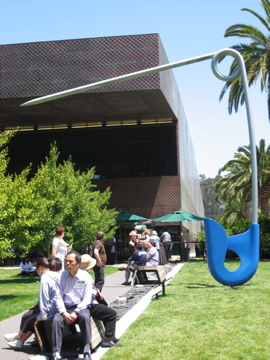
As you walk toward the main entrance of the de Young Museum, you could easily overlook a slim crack running down the center of the pavement. The crack stretches to a large squared chunk of stone, splits the stone in two, and continues into a courtyard, where it branches off in half a dozen crooked paths to break through other stone blocks.

This arrangement is a commissioned work by British artist Andy Goldsworthy. When Goldsworthy learned that the chosen material for the piece was Yorkshire sandstone (which also surrounds the museum), he became intrigued by the way that the stone splits.. “The crack and the hole have been an important recurring feature in my art for a long time,” Goldsworthy comments in a recorded audio guide to the museum. “They are windows into the stone, or a release of the energies inside the stone. They are a way of both looking in and looking out of the stone.”

Cracks and fissures have particular meaning in the San Francisco Bay area, and in light of the deYoung’s history, Goldsworthy notes. He likes the idea that visitors don’t immediately recognize his work as art. “People see it and probably think it’s a fault in the building, which I adore. It’s so opposite what you would normally get in front of a museum.”


Cornelia Parker, “Anti-Mass,” 2005

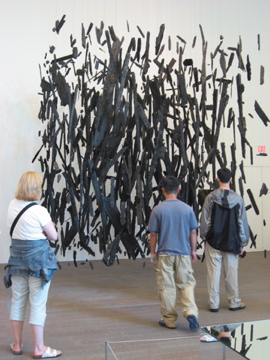
This hanging sculpture is made from charred fragments of a black southern Baptist church destroyed by arsonists.

The piece dominates the room with its ominous presence. Even before I read about the work, I thought it looked like an arrested explosion.

“Mass” refers to both the amount of matter in an object and to a religious ritual. A placard near the he piece states that the installation is meant to evoke “both the lost church and the bodily presence of the congregation through an absence more powerful than any figurative image.”

Striking new San Francisco museum (3 of 4)


De Young Museum, Golden Gate Park
San Francisco
17th-20th century American art and art of the native Americans, Asia and the Pacific

Part 3 of 4
Good Eats

At the opposite end of the museum from the tower, there is a public sculpture garden and café tables under a huge cantilevered overhang. Somehow the massive roof reads as sheltering, not dark or looming.

The patio is a pleasant place to enjoy a meal, and the café’s repertoire goes far beyond sandwiches. The menu changes seasonally, and all dishes are made with fresh local ingredients from small farms and artisanal producers.

A glance at the current (autumn) menu makes me want to return:

- Barley risotto with mushrooms, roasted butternut squash and jack cheese

- “Fisherman’s Wharf” salad, with marinated calamari, shrimp, Dungeness crab, fennel and fresh pomegranate

- Seared pork chop with apple-apricot chutney, cranberry bean ragout, sautéed red cabbage with apple and pancetta

The Bay Area is truly foodie heaven.

Update, 1/28/07: To see more exterior photos and a review of the de Young building, here's an article by Canadian architect and writer Witold Rybczynski at Slate.com.

Striking new San Francisco museum (2 of 4)


De Young Museum, Golden Gate Park
San Francisco
17th-20th century American art and art of the native Americans, Asia and the Pacific

Part 2 of 4
Observation Deck
The tower portion of the de Young Museum seems to twist away from the rest of the building until it aligns with the grid of the surrounding neighborhood. The new tower space is entirely devoted to education, making it the largest such dedicated space in any American museum, according to a museum flyer.

The tower also is a reference to the tower of the original de Young museum. The original building, which opened to the public in 1919, was damaged beyond repair in the 1989 Loma Prieta earthquake.

Wow. The view from the ninth-floor observation deck is not for those prone to vertigo. Step from the elevator and turn right, and the polished hardwood floor seems to lead you straight off the building’s edge. Floor-to-ceiling glass panels are interrupted only by black seams about every three feet.

I have no problem with heights, but my stomach lurched a tiny bit with the first impact of the view. The punctuated copper sheeting starts just above eye level, hanging out about two feet from the glass. It feels sheltering, not obstructive.

On a clear day, you can see the towers of the Golden Gate Bridge behind a forested hill that is part of the Presidio, with the Marin Headlands beyond. Golden Gate Park extends to the ocean. Across a plaza, beyond a bandshell, a new building for the California Academy of the Sciences is under construction. I also identified Twin Peaks, the highest point in San Francisco, and the iconic TransAmerican pyramid.

One of the supporting walls in the center of the room, part of the elevator shaft, bears a 10 X 12-foot satellite photo of the museum site, with that eerie precision delineating every structure and street. The shift in perspective, from the windows to the wall, is startling, like suddenly standing on your head, as your brain tries to translate from the 3-D view beyond the glass to the 2-D aerial view.

Update, 1/28/07: To see more exterior photos and a review of the de Young building, here's an article by Canadian architect and writer Witold Rybczynski at Slate.com.

Striking new San Francisco museum (1 of 4)


De Young Museum, Golden Gate Park
San Francisco
17th-20th century American art and art of the native Americans, Asia and the Pacific

San Francisco’s newest museum is a must-see, whether it’s your first visit to the city or your twentieth. The building itself is intriguing enough to merit a trip, and an incredible ninth-floor observation deck offers an unequaled view.

Part 1 of 4
Exterior

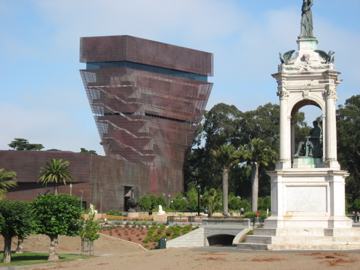
The new de Young Museum is sheathed in panels of scored and punched-out copper, almost like scaffolding, with irregular horizontal slits exposing slim vertical metal columns and dark glass.

The copper façade is meant “to replicate the impression made by light filtering through the tree canopy,” according to the museum’s Web site. It will blend into its surroundings even more as the material oxidizes, producing copper’s familiar greenish patina.

Update, 1/28/07: To see more exterior photos and a review of the de Young building, here's an article by Canadian architect and writer Witold Rybczynski at Slate.com.

Monday, November 06, 2006

Beautiful spirals


Can you identify this vegetable?

Yes, it is an edible food, not a fossil shell or a prop from a sci-fi movie.

Two people I showed it to had the same comment, "How fractal!"

This startling veggie is romanesco, a member of the species Brassica oleracea, which includes broccoli, caulifolower, cabbage, Brussels sprouts, collard greens, and kohlrabi.

I'd never seen or heard of it until last week, when I came upon some at my local farmers' market. I waited until I saw another customer put one in her shopping basket, and she kindly answered my questions.

Steamed romanesco tastes like mild cauliflower. My fellow shopper says that she has only seen it in farmers' markets. Certainly my local Whole Foods market doesn't carry it.

This green cauliflower apparently is more common in Europe than in the U.S. I love the German name: Pyramidenblumenkohl ("pyramid cauliflower").

Need to know how to say "red cabbage" in Finnish? Look at this interesting Web site I discovered while searching for romanesco; it has names for vegetables in more than 60 languages, including phonetic spellings for some of the non-Latinate languages.

It's "punakaali," in case you were wondering.