From the Democratic Senatorial Campaign Committee:
1. $319 billion: The amount earmarked for the Iraq war, with no end in sight
2. $10 billion: The value of no-bid contracts Halliburton received in Iraq
3. 1 in 5: The number of American children living below the poverty line, an increase of 12% since George Bush took office
4. $300 billion: The projected 2006 deficit under George Bush
5. 6 million: The number of working Americans who have lost their health insurance since George Bush took office
7. 0: The number of mistakes George Bush admits to making in his first term
Thursday, August 31, 2006


Wednesday, August 30, 2006
A woman's place

Capistrano Beach, Calif.
Church Fires Teacher for Being Woman
By THE ASSOCIATED PRESS
Published: August 21, 2006
Filed at 8:40 a.m. ET
WATERTOWN, N.Y. (AP) -- The minister of a church that dismissed a female Sunday School teacher after adopting what it called a literal interpretation of the Bible says a woman can perform any job -- outside of the church.
The First Baptist Church dismissed Mary Lambert on Aug. 9 with a letter explaining that the church had adopted an interpretation that prohibits women from teaching men. She had taught there for 54 years.
The letter quoted the first epistle to Timothy: ''I do not permit a woman to teach or to have authority over a man; she must be silent.''
The Rev. Timothy LaBouf, who also serves on the Watertown City Council, issued a statement saying his stance against women teaching men in Sunday school would not affect his decisions as a city leader in Watertown, where all five members of the council are men but the city manager who runs the city's day-to-day operations is a woman.
My initial, gut reaction to this story was to feel relief that I have only sons, not daughters. My boys will undoubtedly encounter prejudice, but it’s unlikely anyone will ever fire them, from a job they have held for decades, because they are men.
A local news channel quotes Lambert as saying that she and the church pastor have had “differences of opinion concerning the direction of the church.” The final sentence of the Associated Press story says that “other issues were behind Lambert’s dismissal,” but church board members chose not to elaborate.
The pastor and the church's deaconate board addressed these "issues" a few days later in the local news. At this time they stated that the scriptural imperative was "only a small aspect" of the decision, and that "Christian courtesy" prevented them from saying anything more -- implying, of course, that the woman who took her story to the media was behaving in a way that was neither Christian nor courteous.
To claim that Lambert was fired because of a re-interpretation of the New Testament appears to be a sneaky attempt to put a holy stamp on the board's actions, when it seems to me that what is going on here is more political, or personal. Would these “issues” have been a firing offense if Lambert was a man?
I belong to a church in which women are fully represented in all positions of teaching, leadership and decision-making. It is not the denomination in which I was raised. When my sons were old enough to start asking questions, and I began looking for a place that I hoped would become their spiritual home, I had to confront the gaps between what I was taught as a child and what I had come to believe with time and life experience.
It took me a while to comprehend how important it was for me to see women preaching a sermon, presenting a report from the church's board of trustees, chairing the annual capital campaign, and donning hard hats to break ground for a new church building.
If I had a daughter, I realized, I could not raise her within a religious tradition that would bar her from participating in some part of that community. And I don't want my children, regardless of gender, to be told that women are not credible as leaders, spiritual or otherwise.
Recently I had a bedtime conversation with my oldest son about the people pictured on U.S. currency. E asked me to tell him again about the woman on the gold dollar coin. Then he wanted to know why she was the only woman, why all the other figures were men.
I explained that at one time, women were not permitted to vote, that they were primarily expected to be mothers and take care of their homes, and that they were not considered capable of being leaders. My son’s mouth hung open in surprise. “Why would anyone ever think that?” he asked. Indeed.
Thursday, August 24, 2006










Sunday, August 20, 2006
Art in your neighborhood
Storefront Art That's Turning Heads
By Jessica Dawson
Special to The Washington Post
Saturday, August 19, 2006; C01
Until Sept. 20, a trio of massive concrete-and-steel heads occupies a vacant storefront in the heart of Logan Circle's condominium and retail district. The heads are a striking art installation called "Memorial (Collapse)" by the South African-born artist Ledelle Moe. You may visit anytime, day or night. And you should.


Eerie exhibit: Ledelle Moe's concrete-and-steel "Memorial (Collapse)." (From The Artist)
I wonder why this sort of exhibit doesn't happen more often in vacant retail space. It would seem to benefit everyone involved, especially in the case of a massive work like this one. Perhaps it only works in an urban setting like Logan Circle, where there is a fair amount of pedestrian traffic.
Saturday, August 19, 2006
She seemed like a reasonable woman
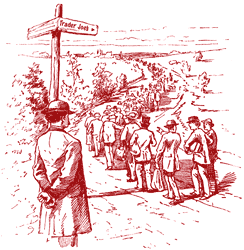
The customer in front of me in line at the Trader Joe’s grocery store this afternoon was an interesting personality study.
I didn’t take much note of her at first. All that registered was her light grey hair, worn in a no-nonsense, chin-length style, and the unusual pattern of her sleeveless blouse in shades of orange.
This customer began taking her groceries out of the cart and piling them at the checkout. At Trader Joe’s, the usual procedure is that the checker pulls your shopping cart behind the counter and takes everything out, ringing up items as s/he goes, and then quickly and efficiently bags everything while you’re paying.
The checker politely asked the woman to stop unloading the cart and allow her to handle the bagging. (There is very little room at the customer’s end of the counter.) Customer explained, nicely, that she was late for an appointment. Checker responded that things would go faster as soon as she was done with the previous customer and could empty the cart herself.
Customer kept unloading groceries, repeating that she was in a hurry and was trying to help. Checker kept pointing out that this was not helpful. They finally achieved a sort of stalemate, probably because there was no more room to stack anything. Customer said, in a mildly offended tone, “OK, I’ll just stand here and do nothing.”
Checker suggested that Customer could bag the groceries, that this might speed things along a little. “Oh, I’m not a professional bagger,” Customer said. “None of us are,” Checker answered, even more politely, with only the tiniest roll of her eyes.
Customer then proceeded to 1) caution Checker not to make any bag too heavy, as she had an injured back, 2) repeatedly and emphatically tell another employee who stepped up -- either to bag or to run interference, I couldn’t tell -- that they should stop moving items around in the store because she couldn’t find anything, 3) state that she never shopped in this store, and 4) offer a faux apology for “just trying to help.”
The entire conversation was conducted in calm, measured tones. If you didn’t listen to the content, you’d think they were chatting about the weather, or the price of Trader Giotto’s Marinara Sauce.
The peculiar part was the insistence of Customer that she WAS, actually, helping. It was as if she wanted to force Checker to retract her previous statement and express thanks for the interference.
I wondered about Customer. Is this a woman who always has to be right? Is she a little confused? (If she “never” shopped at this store, how did she know they were rearranging it?) Is she always so passively aggressive, or does she only pick on people who are in no position to tell her off?
To be fair, Checker also seemed intent on making Customer admit that she was being a pain in the derriere. At one point, when Customer was gone and Checker was waiting on me, she said quietly, to no one in particular, “I just don’t feel like arguing with anyone today.” I said nothing but thought: So don’t argue. Why do you have to be right? She might have sent Customer on her way a little faster if she’d smilingly agreed to everything Customer said while doing it her own way as best she could.
When I waited tables in college and graduate school, it was drilled into me that the first order of business was to pleasantly do all that was in my power to make the customer happy. If that didn’t work, I was to summon a manager and hand the problem over to him or her. The manager has more power and, ultimately, more responsibility. It wouldn’t have occurred to me to argue with even the most flaming idiot. I wasn’t getting paid enough to do that.
All I can say is: Be gentle with each other, folks.
Saturday, August 12, 2006
Datelines
When I started my first job out of graduate school, as a writer at a group of medical trade newspapers, I posted this list of cities on the cubicle wall above my typewriter.*
* Yes, a typewriter! We used electric typewriters and actual carbon paper for the first few years I worked there. Cut-and-paste was meant, and done, literally. No, I am not that old. It was an antiquated office.
The list comes from the style book of the Associated Press, an industry standard. These cities stand alone in the dateline of a news story, without being followed by the state name or country. Presumably these cities are known well enough that the average reader doesn't need any more information
Every time I visited a new city on the list, I'd check it off. I wondered how many of these cities I would ever visit.
Nearly 20 years later, my updated list shows that I have been to 30 of the 57 cities. If you just consider American cities, it's 23 of 30.
I would like to check off at least 5 or 6 more.
| Atlanta Baltimore Beijing Berlin Boston Chicago Cincinnati Cleveland Dallas Denver Detroit Djibouti Geneva Gibralter Guatemala City Havana Hong Kong Honolulu Houston Indianapolis Jerusalem Kuwait City Las Vegas London Los Angeles Luxembourg Macau Mexico City Miami Milwaukee | Minneapolis Monaco Montreal Moscow New Delhi New Orleans New York Oklahoma City Ottawa Paris Philadelphia Phoenix Pittsburgh Quebec City Rome St. Louis San Marino Salt Lake City San Antonio San Diego San Francisco Seattle Singapore Tokyo Toronto Vatican City Washington |
* Yes, a typewriter! We used electric typewriters and actual carbon paper for the first few years I worked there. Cut-and-paste was meant, and done, literally. No, I am not that old. It was an antiquated office.
The list comes from the style book of the Associated Press, an industry standard. These cities stand alone in the dateline of a news story, without being followed by the state name or country. Presumably these cities are known well enough that the average reader doesn't need any more information
Every time I visited a new city on the list, I'd check it off. I wondered how many of these cities I would ever visit.
Nearly 20 years later, my updated list shows that I have been to 30 of the 57 cities. If you just consider American cities, it's 23 of 30.
I would like to check off at least 5 or 6 more.
Friday, August 11, 2006
Plot to Bomb U.S.-Bound Jets is Foiled
Britain Arrests 24 Suspected Conspirators
By John Ward Anderson and Karen DeYoung
Washington Post Foreign Service
Friday, August 11, 2006; A01
LONDON, Aug. 10 – A plot to simultaneously blow up as many as 10 U.S.-bound passenger jets with liquid explosives hidden in carry-on luggage was foiled with the arrest of 24 suspects, British and U.S. officials said Thursday. Tough new security measures snarled air traffic through the day and filled departure lounges in Britain and the United States with crowds of frustrated travelers.
Once again, airline security is the topic of the day and we are doing yet another strange dance at the doorways of planes. First we relinquished our nail clippers and doffed our shoes. Now we make our offerings of shampoo and tequila to the circular file. The only cheer in the news (other than the thought that apparently a disaster was averted) came from the photos of smiling people handing off Frappuccinos and bottles of Scotch to strangers, rather than throwing their pricey liquids in the trash.
The miserly corner of my brain wonders if the TSA couldn’t somehow divert all those bins of shampoo and shaving cream to homeless shelters or some other place of need. I suppose the bounty from JFK alone would overwhelm any such effort. Maybe we could load them all on a cargo plane and send them to tsunami-stricken areas. Except that the whole point of this exercise was to keep the items off the planes…
On Saturday, I board a flight from San Francisco to Washington, D.C. with my two children. This does make the packing puzzle more interesting. My carry-on will be a lot lighter without the three bottles of water I’d normally lug. Don’t forget to take my one and only designer lipstick out of my purse and put it in a checked bag – it’s verboten, according to news reports. No contact-lens solution, no eye drops, no decongestant spray – my usual arsenal against the drying, virus-laden aircraft ether.
Nearly five years ago, I was at home with a toddler and an infant when someone called and told me to turn on the TV. The toddler ignored the unbelievable images on the screen while I clutched the baby to me. I think I held him for most of the day. I kept imagining a man looking at the faces around him, at children like my own, and continuing to crash a plane, to consign them to the flames.
The next time I turned on the TV, the Pentagon was burning. I phoned a friend who worked in DC. “No, no, it’s the World Trade Center,” she said patiently. “NO, I am looking at the Pentagon,” I said, and then we both fell silent.
By John Ward Anderson and Karen DeYoung
Washington Post Foreign Service
Friday, August 11, 2006; A01
LONDON, Aug. 10 – A plot to simultaneously blow up as many as 10 U.S.-bound passenger jets with liquid explosives hidden in carry-on luggage was foiled with the arrest of 24 suspects, British and U.S. officials said Thursday. Tough new security measures snarled air traffic through the day and filled departure lounges in Britain and the United States with crowds of frustrated travelers.
Once again, airline security is the topic of the day and we are doing yet another strange dance at the doorways of planes. First we relinquished our nail clippers and doffed our shoes. Now we make our offerings of shampoo and tequila to the circular file. The only cheer in the news (other than the thought that apparently a disaster was averted) came from the photos of smiling people handing off Frappuccinos and bottles of Scotch to strangers, rather than throwing their pricey liquids in the trash.
The miserly corner of my brain wonders if the TSA couldn’t somehow divert all those bins of shampoo and shaving cream to homeless shelters or some other place of need. I suppose the bounty from JFK alone would overwhelm any such effort. Maybe we could load them all on a cargo plane and send them to tsunami-stricken areas. Except that the whole point of this exercise was to keep the items off the planes…
On Saturday, I board a flight from San Francisco to Washington, D.C. with my two children. This does make the packing puzzle more interesting. My carry-on will be a lot lighter without the three bottles of water I’d normally lug. Don’t forget to take my one and only designer lipstick out of my purse and put it in a checked bag – it’s verboten, according to news reports. No contact-lens solution, no eye drops, no decongestant spray – my usual arsenal against the drying, virus-laden aircraft ether.
Nearly five years ago, I was at home with a toddler and an infant when someone called and told me to turn on the TV. The toddler ignored the unbelievable images on the screen while I clutched the baby to me. I think I held him for most of the day. I kept imagining a man looking at the faces around him, at children like my own, and continuing to crash a plane, to consign them to the flames.
The next time I turned on the TV, the Pentagon was burning. I phoned a friend who worked in DC. “No, no, it’s the World Trade Center,” she said patiently. “NO, I am looking at the Pentagon,” I said, and then we both fell silent.
Sunday, August 06, 2006
Seen and heard @ the Palo Alto Farmers' Market
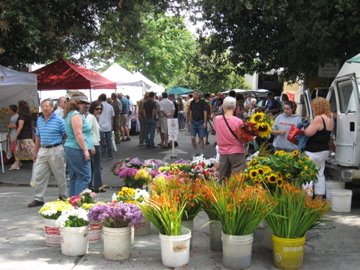
It’s a cliché, but it really does make a difference to see the faces of the people who produce the foods that you eat. I want the kids to know that farmers aren’t just Old MacDonald. They are young and old, male and female, families with young children and grandparents. There’s little satisfaction in buying shrink-wrapped veggies at the grocery store, much more in choosing from heaps and baskets of colorful fruit and knowing that it’s come straight from the field.

The Four Finger String Band was here again: folk music, a woman playing violin and men playing banjo, bass and guitar. I tend to think of the banjo as an older-man’s instrument, perhaps because my father used to play, so it tickled me to see a young barefoot tattooed guy picking away like mad. A market staffer buying the musicians drinks at the Mexican food stand commented, “The fish guy says he sells more fish when they’re here. (The band members) want to know if they can put that on their Web site: `Our music sells more fish!’”

What went home in my market bag? I bought late apricots from a grandma (she was talking about her grandsons with another customer) who advised me to leave them out on the counter for a few days to ripen. I picked out a small cantaloupe at another stand; “We have bigger ones,” the farmer pointed out, wanting to make sure that I felt I got my money’s worth. Also a seeded sourdough baguette, peaches, grapes, and strawberries. We’re going to have shortcake tonight. Maybe for dinner.
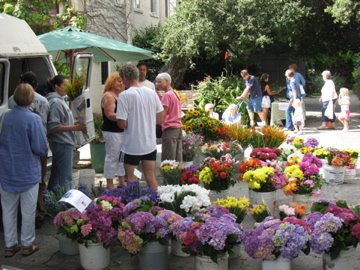
A glimpse of a woman walking by reminded me so much of my late maternal grandmother that it was like a poke in the stomach. I don’t know why she affected me so. She didn’t really look that much like H. It was something about her unaffected smile, and her summer gardener’s tan.

There’s a German bakery stand that sells poppy-seed and nut rolls (not quite as good as the ones Grandma used to make) and bienenstich, or "bee-sting cake," a custard-filled yeast bread topped with honey and almonds.
The stall where I bought bread (they must have two dozen varieties, at least) also makes a spiral sweet roll filled with raisins, dried cranberries and/or chocolate chips that they call an escargot. Cute and delicious; E’s favorite thing in the market. C is partial to the blueberry-cream cheese Danish.
Ah, the crepe stand. Two blocks away from the market, a woman passing by looked at the buckwheat crepe I carried on a paper plate and sighed, “Those are SO good.”
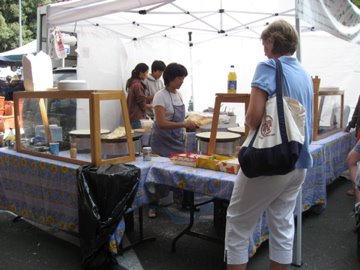
When B and I lived in Paris on Rue Mouffetard, a market street, there was a sidewalk crepe seller just steps from our door. That summer I overdosed on crepes filled with Nutella; I haven’t been able to eat the stuff since. (This was in 1995.) But I’ll take a lovely crepe beurre-sucre any day. Just hot thin pancake, sweet butter and sugar. This morning, since I hadn’t had breakfast, I indulged in a crepe filled with crabmeat, avocado, sliced asparagus, cheese, and a light lemon sauce.
I also bought a cup of hot Oaxacan Mexican chocolate, not too sweet, all foamy milk chocolate and cinnamon. The stand sold three types of agua fresca: fresh cantaloupe, blueberry-blackberry, and horchata, a mixture of rice, almond and cinnamon. I wanted to try them all, but chocolate won out.
Thursday, August 03, 2006
Artful, seasonal food @ Kaygetsu


Kaygetsu Restaurant
Menlo Park, Calif.
The Japanese meal known as kaiseki began as a set of small courses served during the tea ceremony. The Chinese characters for cha-kaiseki (tea kaiseki) mean “warm stone.” This refers to a practice of Zen Buddhist priests, who would tuck heated stones beneath their robes to ward off cold and hunger pains.
Japanese restaurants began to serve a more casual form of kaiseki in the 19th century, and this meal is described with the Chinese characters meaning “to meet” or “to gather.”
In kaiseki, the ingredients and even the tableware are carefully chosen to reflect the season. Chefs Shinichi Aoki and Katsuhiro Yamasaki change their menu at Kaygetsu every six weeks.
It’s hard to reconcile the idea of this ritualized meal with the strip-mall setting of Kaygetsu. The restaurant makes up one corner of a suburban shopping area, next to a Safeway and a Longs Drugstore. Sushi chef Toshi Sakuma and his wife Keiko have been greeting guests here since they opened Kaygetsu in April 2004.
The restaurant’s interior is spare, with warm pale walls and dark wood trim, enlivened by a few small woodblock prints and formal flower arrangements. There are perhaps 15 tables, set fairly close together. (I heard more than I wanted to know about my neighbor’s quirky relatives and recent pregnancy.) But I only noticed these things during brief pauses in the well-paced, nine-course meal. The food successfully held my attention.
Our sakizuke (starter) was flash-fried cheeks of sea bass, the choicest part of the fish, topped with yama ima potato, okra radish sprouts, and ginger threads. Alongside the fish was a gelatin flavored with ponzu, a citrus fruit resembling a lemon. The gelatin tasted salty and smoky, like bacon, with just a touch of citrus, somewhere between lemon and grapefruit. This course was served on a rough earthenware platter, rectangular in shape wth turned-up corners.
We tried the sake pairing of four different types. The first, dewazakura daiginjo, was the most floral, almost like a white wine. It was the only one of the four served in a distinctive glass chalice, with a frosted base and the character for “sake” engraved on the bowl. The other three sakes arrived in tall shot glasses with flared rims, each set into a clear plastic box that served as a coaster.
The second sake, masumi yamahai jinjo, which was described in the menu as “rich, aromatic and robust,” didn’t make much of an impression on me. Third was a “lightly cloudy sake,” otokoyama sasaori nama zake, which was refreshing. I preferred it to the fourth, kokuryu tokusen ginjo, which was said to have “fragrant aroma with strength and depth.”
The next course was hiyashi suimono, cold soup. The cheery yellow corn soup, which arrived in a small stemmed glass, was a pleasing contrast to the blue-and-white-patterned serving plate. The soup was chilled but not cold, thin and sweet but not cloying. At the bottom of the glass were gossamer sheets of fresh yuba, or tofu skin, which gave the soup some substance, rather like Chinese egg-drop soup.
A sashimi course followed. The raw fish nearly melted in my mouth, it was so fresh and delicate. The plate included o-toro, or fatty tuna, plus striped bass and snapper. The fish slices were carefully arranged in a garden of microgreens and snapdragon heads, on a green-glazed pottery dish with linear patterns of red and green. Among the greens was a showy bright-red leaf that I didn’t recognize; the server told me it was Japanese water pepper.
Course number four, takiawase (slow-cooked dish), was not the stew I expected but pristine vegetables in fish broth clear as water. A few string beans, red bell pepper slices, a chunk of dried tofu (now spongy, after cooking in the broth), shiitake mushroom slices, green winter melon and orange kabocha squash made for a colorful arrangement. Kabocha, which the server described as Japanese pumpkin, was closer to a sweet potato in texture and taste.
Next was a different kind of sushi course, called shinogi, or intermezzo. The first thing I noticed on the plate was what appeared to be a slice of beef. Indeed it was “Kobe beef nigiri,” extremely tender, roasted rare and sliced thickly. Instead of the traditional wasabi, this sushi was topped with more ponzu and a dab of what seemed to be horseradish. The other item on the long, tapered white plate was marinated salmon and sushi rice, shaped into a pyramid and completely wrapped in a bamboo leaf. (Is bamboo edible? I don’t think so, unless you’re a panda.)
The agemono, or deep fried dish, was flounder with plum sauce. The crispy fish was wrapped in shiso, an aromatic green that's also referred to as Japanese basil. Next to it was a ball of shrimp with snow peas, fried until crunchy, rather like tempura, and served with an intriguing condiment, a mixture of powdered green tea and salt.
Our last “main course” was yakimono, or “grilled dish,” in this case a slightly sweet grilled chicken with miso sauce, and a few spoonfuls of barley cooked in the same miso. Next to the chicken was a tiny white hexagon-shaped cup of what looked like dessert, maybe a demitasse-sized sundae with a cherry on top. Actually it was thin slices of kiwi fruit, and the “whipped cream” was made from tofu, with a bit of marinated cherry tomato. Perhaps it was meant to be a refresher, but it seemed an odd thing to be paired with the chicken. This course was served on the most interesting plate, shaped like a long thin green leaf with pointed ends -- maybe a bamboo leaf? – and a scored pattern on the surface.
Our server told us that the broiled unagi in the next course -- gohanmono, or rice dish -- was a type of Japanese freshwater eel that’s not as rich as the eel usually served as nigiri sushi. This eel was quite mild, served over steamed rice with wasabi that we were instructed to stir into more of the perfectly clear fish broth. The inevitable pickled vegetables (they seem to come with any Japanese meal) came on the side. I liked the way the pale eel meat and white rice contrasted with the brown-striped serving bowl.
I was looking forward to the final course, a “house-made original dessert” described as peach crème brulee. The surprise under the properly crackling broiled-sugar crust was small chunks of fresh white peach buried in the cool custard. The dessert had a great fresh-peach flavor. But in the end, I decided that the fruit detracted too much from the prime characteristic of good crème brulee: the contrast between velvety custard and brittle topping. This theoretical objection did not stop me from eating every last bit!
The service was attentive but not overwhelming. Several times the servers and the sushi chef asked us how we were enjoying our meal, and they seemed quietly pleased and proud when we responded enthusiastically.
A recent review of Kaygetsu in San Francisco Magazine raves that “you could make a meal of Toshi’s amberjack, maguro, and tiny firefly squid.” I would like to return and place myself in the hands of Mr. Sakuma, who has been creating sushi for more than 30 years. The party next to us, who seemed to be regular customers, ordered a huge platter of sushi after conferring with the chef at length. It looked fabulous, and they left nothing behind.
You would think that you should be very hungry to do justice to a nine-course meal. But the food at Kaygetsu is best savored, slowly, and each serving is just enough to get the full flavors and texture of the dish. So you might want to have a snack before you go. But make it a light one.
Looking @ Google
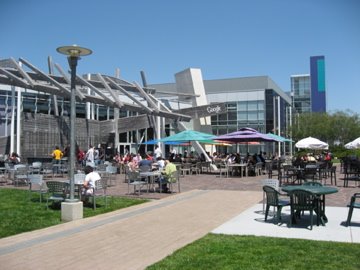

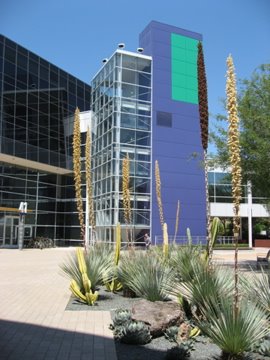
I'm sitting in a plaza between the four striking modern buildings that make up the Google campus. B is spending one or two days a week here, for a six-week mini-sabbatical in the Bay area. I've had lunch and a tour, and I have to echo the question I heard from another visitor: "Does anyone ever voluntarily quit here?
Yellow electric scooters are parked in several spots, available to anyone who wants a quick jaunt across the yard. They seem more popular than the Segways, which I haven’t seen in action yet. There’s something incongruously solemn about the scooters, something about the way the rider glides along so upright and still, but at the same time goofy. (Dude, you’re, like, flying!)
The list of employee benefits goes on.
- Valet parking and on-site oil changes while you work.
- A hair salon in a motorhome, which seems to be parked on campus one or two days a week. The side of the camper reads, "Onsitehaircuts.com – Get in. Get out. Get on with life.”
- Boxes for dropping off dry cleaning.
- Lots of giant bean bag chairs, grouped for conferences or working alone.
- A adjustable-current swimming pool, complete with lifeguard. (That's got to be a boring job - watching a single person swimming in a single lane, never going anywhere.)
- Ellliptical machines and recumbent-bicycles strategically placed near plate-glass windows, scattered throughout the buildings instead of isolated in a health club.
- Very complicated massage chairs.
- Restrooms with Toto toilets. I won't go into detail about what makes these fixtures luxurious. Follow the link if you're curious. I'll just say that this is the first time I'd encountered one in real life, and I am ready to renovate my bathroom.
- More food than you can imagine. There seems to be generous kitchen areas on every floor, all stocked with goodies. The common element is a wall of plastic snack dispensers, the kind of display you see in the bulk-goods aisles of grocery stores. Have a protein bar? A chocolate-covered fig? A bowl of a certain "magically delicious" sugar-coated cereal?
One kitchen had three types of coffee-delivery devices: a regular old drip machine, a traditional espresso machine, and a super-automated machine that offered a variety of brews. B sniffed at my choice, French vanilla, claiming that it “didn’t smell like coffee.” I was testing the massage chair, which was doing some funky shiatsu that made my entire torso jiggle in an unflattering manner, so I didn’t respond to this jibe.
The main cafeteria had at least 8 different stations, all self-serve. It took me several minutes to read the menu posted at the entrance and figure out which goodies I’d most like to try. I ended up with black-bean cakes topped with avocado chunks and drizzled with fluorescent carrot-habonero pepper sauce; from the salad bar, marinated ahi tuna with more avocados (hey, I’m in California), a sorrel salad; smoky black beans, a large piebald type of bean I’d never seen before; a mango smoothie; and a demitasse of extremely rich chocolate mousse with a fresh raspberry on top.
You can tell this place is populated mostly by 20-somethings. I could not work somewhere that provides unlimited It’s-It ice cream treats. I would gain 50 pounds. Even with the swimming pool.

I had to take an It’s-It for the road. The original is the best: two chewy oatmeal cookies, good vanilla ice cream in the center, and dark chocolate over all. I find it fiendishly addictive.
Later I found out that this treat was Google's very own It's-It, and it's healthy, too! Well, healthier than it could be. Check it out on the Google blog.
Subscribe to:
Posts (Atom)