Showing posts with label museum. Show all posts

Wednesday, August 27, 2008

My new toy


This was my gift to myself from the Exploratorium.

It's Constructibles, a set of 25 slotted cardboard shapes to build with.

Want a set of your own? Get one through the Exploratorium Store here (and browse through the other cool stuff they have to play with).

Or go to the manufacturer's site, Mudpuppy, for more pattern options.

Saturday, August 23, 2008

Please touch the exhibits


One of the best things to do in San Francisco, whether you're a child or not, is to visit the Exploratorium. It is the most interesting science museum I've ever seen, perhaps because it subverts the traditional idea of a museum. It's more like a playground combined with an art studio and a workshop where you're allowed to use all the tools. Nothing says "don't touch."

To quote the Exploratorium's Web site, the place is "a collage of hundreds of interactive exhibits in the areas of science, art, and human perception."

You can watch a museum staffer dissect a cow's eye or fertilize sea-urchin eggs. Or draw a picture using a fixed marker pen and a three-foot square pad of paper on a pendulum tray.

Once the boys and I were fascinated by a time-lapse movie showing how the body of a dead bird decays. On this visit, we were spent a lot of time peering under the hood of a car and learning how mechanics diagnose mechanical problems by their sounds.

This playspace invited us to "stack the stars" and figure out how to best arrange them so that there was hardly any space in between. The best part, according to C, was the "tunnels" between the structure and the floor. I had to take his word on that, not being small enough to wriggle through.

(If anyone knows what this shape is called, please comment! I forgot the term. It looks like this stellated dodecahedron.)


The box of magnetic black sand always draws a crowd. It feels almost like stroking a smooth furry animal.


The "Mind" portion of the museum explores how we think and feel. Stand in the middle of a bullseye and look up as directed, and you'll see that a grand piano is hoisted directly overhead, hanging by a single cable. How do you feel about this? Maybe you don't care. Or maybe you feel a little strange, like a target, even though your rational mind knows that you're perfectly safe.

I love watching people approach this exhibit's unusual water fountain. It works as you'd expect, but the water spout is attached to a toilet. The display assures you that this is a brand-new fixture, never used for its apparent purpose. Will you drink from it? (I make a point of doing so whenever I walk by, and every time it requires a tiny bit of mental effort.)

Since you're going to be here for a long visit, it's good to know that you can have a tasty meal or snack. If a young companion demands PB&J or pizza, you can get those. But I enjoyed spicy roasted chicken served with wild rice pilaf and an organic mixed greens salad with a wonderful shiitake-mushroom vinaigrette. And a Haagen-Dazs ice-cream chaser.

Thursday, December 14, 2006

A great place for kids in San Francisco (after you've ridden a cable car and eaten a crab roll on Fisherman's Wharf)


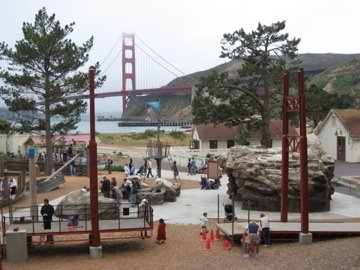
Lookout Cove, Bay Area Discovery Museum, Sausalito, CA

Bay Area Discovery Museum, East Fort Baker, Sausalito, CA
Part 1 of 2

This is a wonderful indoor-outdoor space for children AND their parents. What a luxury: sitting on a park bench, watching my kids have a great time in active play, while over my shoulder is a striking view of the Golden Gate Bridge, the far tower topped with fog.

Two hours after our arrival, the boys hadn't set foot indoors yet; they were busy exploring every foot of Lookout Cove. We found a crow's nest and a real fishing boat to climb in, a "shipwreck" grounded in wood chips where we could dig for buried treasure, "tide pools" and a dark "sea cave" to examine. There's also a small-scale, unfinished Golden Gate bridge waiting for builders, and twisty garden paths perfect for running and hiding.

Adults will find plenty of benches well-sited for observing the fun, plus a cafe serving tasty food and decent coffee. My family could easily spend the day here.

The museum is housed in nine low warehouse-style buildings erected by the U.S. Army in 1903-05 as part of Fort Baker. After an award-winning restoration, the museum opened in 1987. Now the structures contain an art studio, classrooms, a theater, a playspace for the preschool set, and a Wave Workshop that recreates the habitat around the Golden Gate Bridge.

During our visit late last summer we enjoyed a traveling exhibit, an interactive display depicting the Chinese legend of the Monkey King. The videos, murals, and moveable 3-D tableaus kept my sons' attention for quite a while, and the books we brought home continue to be favorites.

There was a sign on the cafe's swinging door that warned against feeding the "aggressive" pigeons. I wanted to laugh; how much aggression could a softball-sized bird deliver? Then one of the feathered rats landed on our picnic table, six inches from C's face, and did its best to make off with an entire oatmeal cookie, while C froze in alarm. We finally managed to shoo it away, after no more than a few pecks at the treat.

Tuesday, November 28, 2006

Striking new San Francisco museum (4 of 4)


Andy Goldsworthy, "Drawn Stone," 2005
de Young Museum


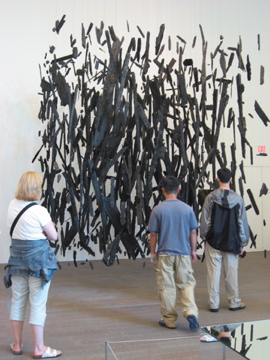
Cornelia Parker, "Anti-Mass," 2005


De Young Museum, Golden Gate Park
San Francisco
17th-20th century American art and art of the native Americans, Asia and the Pacific

Part 4 of 4
Selected works

Andy Goldsworthy, “Drawn Stone,” 2005

As you walk toward the main entrance of the de Young Museum, you could easily overlook a slim crack running down the center of the pavement. The crack stretches to a large squared chunk of stone, splits the stone in two, and continues into a courtyard, where it branches off in half a dozen crooked paths to break through other stone blocks.

This arrangement is a commissioned work by British artist Andy Goldsworthy. When Goldsworthy learned that the chosen material for the piece was Yorkshire sandstone (which also surrounds the museum), he became intrigued by the way that the stone splits.. “The crack and the hole have been an important recurring feature in my art for a long time,” Goldsworthy comments in a recorded audio guide to the museum. “They are windows into the stone, or a release of the energies inside the stone. They are a way of both looking in and looking out of the stone.”

Cracks and fissures have particular meaning in the San Francisco Bay area, and in light of the deYoung’s history, Goldsworthy notes. He likes the idea that visitors don’t immediately recognize his work as art. “People see it and probably think it’s a fault in the building, which I adore. It’s so opposite what you would normally get in front of a museum.”


Cornelia Parker, “Anti-Mass,” 2005

This hanging sculpture is made from charred fragments of a black southern Baptist church destroyed by arsonists.

The piece dominates the room with its ominous presence. Even before I read about the work, I thought it looked like an arrested explosion.

“Mass” refers to both the amount of matter in an object and to a religious ritual. A placard near the he piece states that the installation is meant to evoke “both the lost church and the bodily presence of the congregation through an absence more powerful than any figurative image.”

Striking new San Francisco museum (3 of 4)


De Young Museum, Golden Gate Park
San Francisco
17th-20th century American art and art of the native Americans, Asia and the Pacific

Part 3 of 4
Good Eats

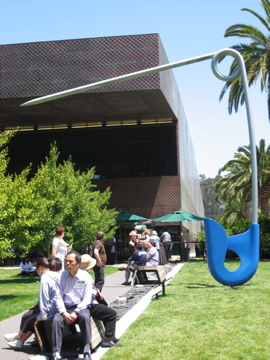
At the opposite end of the museum from the tower, there is a public sculpture garden and café tables under a huge cantilevered overhang. Somehow the massive roof reads as sheltering, not dark or looming.

The patio is a pleasant place to enjoy a meal, and the café’s repertoire goes far beyond sandwiches. The menu changes seasonally, and all dishes are made with fresh local ingredients from small farms and artisanal producers.

A glance at the current (autumn) menu makes me want to return:

- Barley risotto with mushrooms, roasted butternut squash and jack cheese

- “Fisherman’s Wharf” salad, with marinated calamari, shrimp, Dungeness crab, fennel and fresh pomegranate

- Seared pork chop with apple-apricot chutney, cranberry bean ragout, sautéed red cabbage with apple and pancetta

The Bay Area is truly foodie heaven.

Update, 1/28/07: To see more exterior photos and a review of the de Young building, here's an article by Canadian architect and writer Witold Rybczynski at Slate.com.

Striking new San Francisco museum (2 of 4)


De Young Museum, Golden Gate Park
San Francisco
17th-20th century American art and art of the native Americans, Asia and the Pacific

Part 2 of 4
Observation Deck
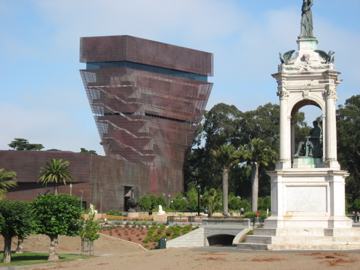
The tower portion of the de Young Museum seems to twist away from the rest of the building until it aligns with the grid of the surrounding neighborhood. The new tower space is entirely devoted to education, making it the largest such dedicated space in any American museum, according to a museum flyer.

The tower also is a reference to the tower of the original de Young museum. The original building, which opened to the public in 1919, was damaged beyond repair in the 1989 Loma Prieta earthquake.

Wow. The view from the ninth-floor observation deck is not for those prone to vertigo. Step from the elevator and turn right, and the polished hardwood floor seems to lead you straight off the building’s edge. Floor-to-ceiling glass panels are interrupted only by black seams about every three feet.

I have no problem with heights, but my stomach lurched a tiny bit with the first impact of the view. The punctuated copper sheeting starts just above eye level, hanging out about two feet from the glass. It feels sheltering, not obstructive.

On a clear day, you can see the towers of the Golden Gate Bridge behind a forested hill that is part of the Presidio, with the Marin Headlands beyond. Golden Gate Park extends to the ocean. Across a plaza, beyond a bandshell, a new building for the California Academy of the Sciences is under construction. I also identified Twin Peaks, the highest point in San Francisco, and the iconic TransAmerican pyramid.

One of the supporting walls in the center of the room, part of the elevator shaft, bears a 10 X 12-foot satellite photo of the museum site, with that eerie precision delineating every structure and street. The shift in perspective, from the windows to the wall, is startling, like suddenly standing on your head, as your brain tries to translate from the 3-D view beyond the glass to the 2-D aerial view.

Update, 1/28/07: To see more exterior photos and a review of the de Young building, here's an article by Canadian architect and writer Witold Rybczynski at Slate.com.

Striking new San Francisco museum (1 of 4)


De Young Museum, Golden Gate Park
San Francisco
17th-20th century American art and art of the native Americans, Asia and the Pacific

San Francisco’s newest museum is a must-see, whether it’s your first visit to the city or your twentieth. The building itself is intriguing enough to merit a trip, and an incredible ninth-floor observation deck offers an unequaled view.

Part 1 of 4
Exterior

The new de Young Museum is sheathed in panels of scored and punched-out copper, almost like scaffolding, with irregular horizontal slits exposing slim vertical metal columns and dark glass.

The copper façade is meant “to replicate the impression made by light filtering through the tree canopy,” according to the museum’s Web site. It will blend into its surroundings even more as the material oxidizes, producing copper’s familiar greenish patina.

Update, 1/28/07: To see more exterior photos and a review of the de Young building, here's an article by Canadian architect and writer Witold Rybczynski at Slate.com.